

Learn where our coffee beans come from, hear the voices of local baristas, and explore how we can keep Wellington’s coffee culture thriving.
scroll to discover ↓


Sections
Skip to a specific section, or scroll for the full experience


To uncover this, we need to explore where our coffee originates, and the journey it takes to reach our local cafes.


2016
120 USD/Lbs
2025
410 USD/Lbs


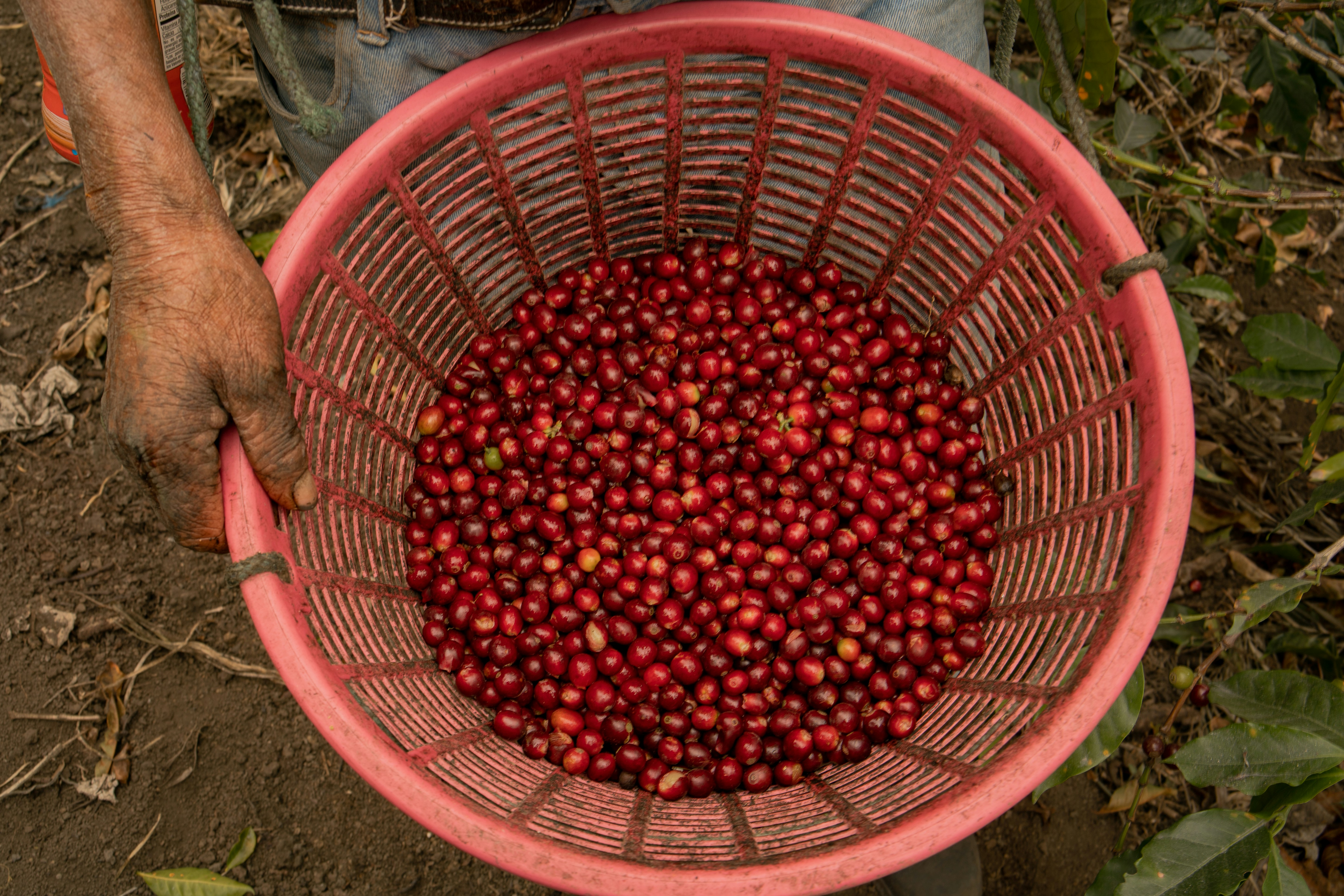
It starts with the Coffea plant. Grown in tropical climates, it produces flowers which develop into coffee cherries.

The cherries take six to eleven months to mature. They start green and gradually turn red or yellow when ripe.

Each cherry normally contains two seeds, the coffee beans. This cycle repeats each year, allowing the plant to produce cherries seasonally.

©Airbus DS 2023


After harvesting, the coffee cherries are processed through one of three main methods2.
Natural Process
Coffee cherries are spread out in the sun to dry, then the outer dried cherry is removed, producing a sweeter coffee bean.

Washed Process
The beans are removed from the cherry, and washed to remove residue. The coffee beans are then dried, producing coffee with a clear flavour profile.

Honey Process
The pulp of the coffee cherry is removed, but the mucilage layer is left intact. The bean is then dried, producing coffee with both sweet and clear flavours.




Coffee's top exporters3 are located between the tropics of Cancer and Capricorn, an area known as the coffee belt (or bean belt).
Growing regions in this area are known for their warm tropical climates, rich soils, and high altitudes, optimal for growing coffee.
Growing coffee beans is only part of the process.
The full journey is far more complex.
In the past few years, global challenges have impacted distribution, raising coffee’s price.


Coffee harvests are heavily impacted by extreme weather. Frosts in Brazil, droughts in Vietnam4, and unpredictable rainfall patterns have already cut supply5.
Additionally, scientists warn that climate change could make half of current coffee land unsuitable by 20506. This puts strain on coffee supply both now and in future.
Rising Farm Costs
Coffee farmers already struggling with crop disease and climate change now also
face rising fertiliser prices and labour shortages, reducing crop yield and quality7.
The higher production costs and lower yield means that before beans even leave the farm, the baseline price of coffee has increased.
Supply Chain Pressures
Coffee travels thousands of kilometres from farm to cup, relying on a complex global supply chain of collectors, drivers, ocean freight, and distribution8.
In recent years, this chain has experienced major disruptions and cost surges, with container shortages, port congestion, and soaring freight rates8, hitting remote importers like us in New Zealand especially hard.
Growing Demand, Tight Supply
Global coffee consumption is rising, and predicted to hit record highs in future9, in part due to increased demand in China10.
However global coffee stockpiles remain low9. With little buffer, even small supply shocks can push prices up sharply.
U.S. Tariffs
Trade policies in the United States, the world’s largest coffee importer, impact the global market. This changes prices everywhere.
The U.S. recently imposed a 50% tariff on Brazilian coffee, lifting global Arabica prices11. Since Arabica is benchmark-priced globally, all importers now face higher costs.
These global issues push coffee prices higher, and those increases flow through to what we pay in New Zealand.


Roasting coffee removes moisture from the beans, producing their recognisable aroma and flavour. After roasting, the beans are immediately exposed to air or water to cool, then packaged for distribution.


Local cafes then grind the beans and extract an espresso shot, finally producing your coffee.
Firsthand accounts from baristas on what it means to be part of Wellington’s cafés, and coffee culture today.
Jessie on Coffee's Shifting Landscape

Growth, connection, and why creativity within Wellington's cafés is important.
Owen on Authenticity in Cafés

New growth, rising costs, and why cafés with character matter in Wellington.
Chris on Resilience in Coffee

How making, learning, and sharing keeps coffee alive
Ella on People and Connection

Balancing love for customers with the realities of running a cafe in tough times.
Sources
Trading Economics. (n.d.). Coffee Price Data. https://tradingeconomics.com/commodity/coffee
National Coffee Association. (2024, December 6). Lifecycle of Coffee. NCA - About Coffee. https://www.aboutcoffee.org/origins/lifecycle-of-coffee/
Torg. (n.d.). Top 10 coffee producing countries in the world. https://usetorg.com/blog/coffee-producing-countries
Brasch, B. (2025, February 26). Why your coffee fix has gotten so pricey — and it will only get worse. The Washington Post. https://www.washingtonpost.com/business/2025/02/26/coffee-price-inflation-tariffs/
Terrascope. (2025, April 17). Brewing a sustainable Future: the carbon footprint of your coffee. CDP. https://cdp.net/en/insights/brewing-a-sustainable-future-the-carbon-footprint-of-your-coffee
Bunn, C., Läderach, P., Rivera, O. O., & Kirschke, D. (2014). A bitter cup: climate change profile of global production of Arabica and Robusta coffee. Climatic Change, 129(1–2), 89–101. https://doi.org/10.1007/s10584-014-1306-x
Zamora, M., & Kepes, Q. (2022, October 4). When Coffee Farmers Face Crises, Farmworkers Suffer Most. Daily Coffee News by Roast Magazine. https://dailycoffeenews.com/2022/10/04/when-coffee-farmers-face-crises-farmworkers-suffer-most/
Schwarz, S. (2025, August 10). Supply chains and shipping: The cost of getting coffee to cup. https://www.linkedin.com/pulse/supply-chains-shipping-cost-getting-coffee-cup-dr-steffen-schwarz-hn2te/
U.S. Department of Agriculture. (2025). Coffee: World Markets and Trade. In UDSA. https://apps.fas.usda.gov/psdonline/circulars/coffee.pdf
Asia Pacific Coffee Market. (2025, June 20). Mordor Intelligence. https://www.mordorintelligence.com/industry-reports/asia-pacific-coffee-market
The Guardian. (2025, August 16). Trump’s cold brew: New York coffee shops warn of higher prices amid steep tariffs. The Guardian. https://www.theguardian.com/us-news/2025/aug/16/coffee-shops-brazil-trump-tariffs
Image Sources
Unsplash
Pexels
Burst
Airbus. (2019, June 18). Melbourne Port Satellite image from Vision-1. https://space-solutions.airbus.com/resources/satellite-image-gallery/various/vision-1-satellite-image-melbourne-port-zoom/
Airbus. (2022, January 14). Port of Nemrut Bay, Turkey Satellite image from Vision-1. https://space-solutions.airbus.com/resources/satellite-image-gallery/various/vision-1-port-of-nemrut-bay-turkey/
Airbus. (2023, March 30). Coffee Plantation, Brazil, Satellite Imagery. https://space-solutions.airbus.com/resources/satellite-image-gallery/pleiades-neo/coffee-plantation-brazil/
MapSVG. (n.d.). World Vector Map. https://mapsvg.com/maps/world
World Map. (n.d.). Mapbox. https://console.mapbox.com/studio/styles
